

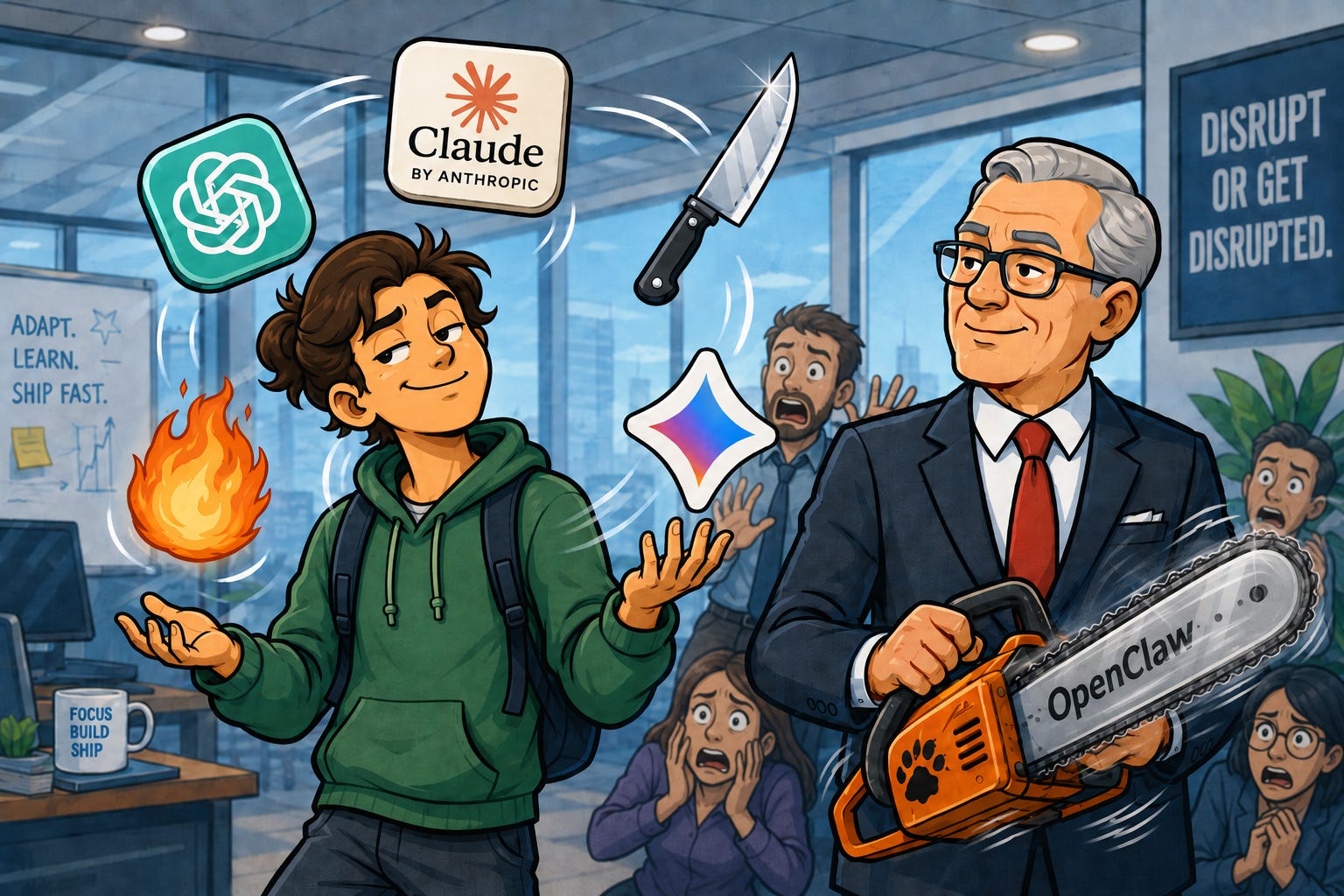
When speaking to schools and organizations, this framing seems to really resonate and help clarify thinking:
AI is a power tool. Like a chainsaw, or fire, or a knife.
One of the biggest challenges around AI is being asked to hold two seemingly contradictory truths in mind: it is a dangerous, unreliable liability for both you and society; and it is incredibly useful and represents the future of work.
It can be both. Because it is a power tool. Take the knife example:
A knife can be uniquely useful *and* it can cause life-threatening harm.
We haven't banned knives from our homes. But...
they play a very specific, well-understood role (usually in the kitchen)
we don't hand them out in schools or let children handle them (but they use conceptual toy versions, e.g. cooking sets
we are taught to use them carefully when we finally start using them
Juggling Knives (It’s free!)
Right now we're at the 𝘫𝘶𝘨𝘨𝘭𝘪𝘯𝘨 𝘬𝘯𝘪𝘷𝘦𝘴 stage of AI.
Handed out enthusiastically with minimal appropriate context, incentivized to use as much as possible and all the time (Drawing a picture? How about a knife? Brushing your teeth? Have you tried a knife?), and yet seem surprised when we hear stories of self-harm and misuse. Especially our youth and lower digital literacy adults (including in our workplaces).
99% of AI Literacy offerings are still focused on learning how to use the tools. Prompting tricks. Juggling.
Critical AI Literacy is learning how the tools use you. How they work, the damage they can do, their context in society—before you handle them at all.
The market is awash with the former, and dangerously thin on the latter. From our schools to our workplaces. "Free" education offerings that are most often user acquisition of vulnerable populations, masquerading as well-rounded awareness and use.
Until we clarify what these tools are for more people—not just how to superficially use them—we will continue to struggle and debate a duality that isn’t nearly as contradictory as it seems when given the necessary framing.
My name is Mario Vasilescu. I’m doing what I can to fight this with humane tools, research, and speaking rooted in Critical AI Literacy. Follow along if this was useful, leave a comment if you have any other helpful resources or nuances to add.
More context: i’m co-founder of Readocracy (tools for expanding how learning is recognized and rewarded in society), lead author of the 3R3C Framework for AI in Education, AI Scholar in Residence at HACC, Chair of the Center for Applied Information Health, and a Salzburg Global Fellow. Robotics engineer turned designer, founder, and speaker around rethinking learning in society and the impact of technology. I believe in you.