

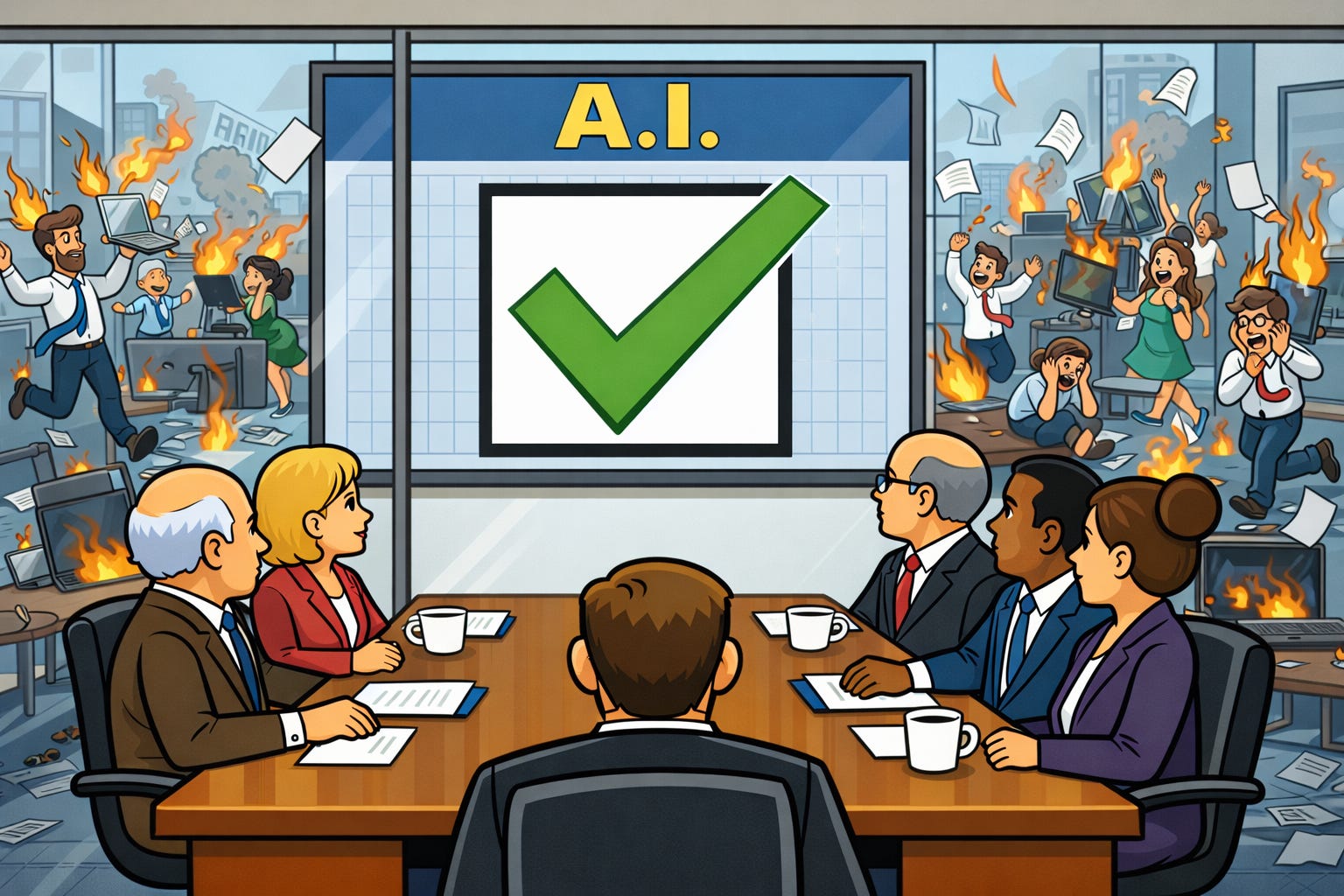
AI is supposed to change the world. Yet 95% of AI deployments aren’t delivering value, and the average person is wary of AI. As a Senior Fellow at Wharton summarized:
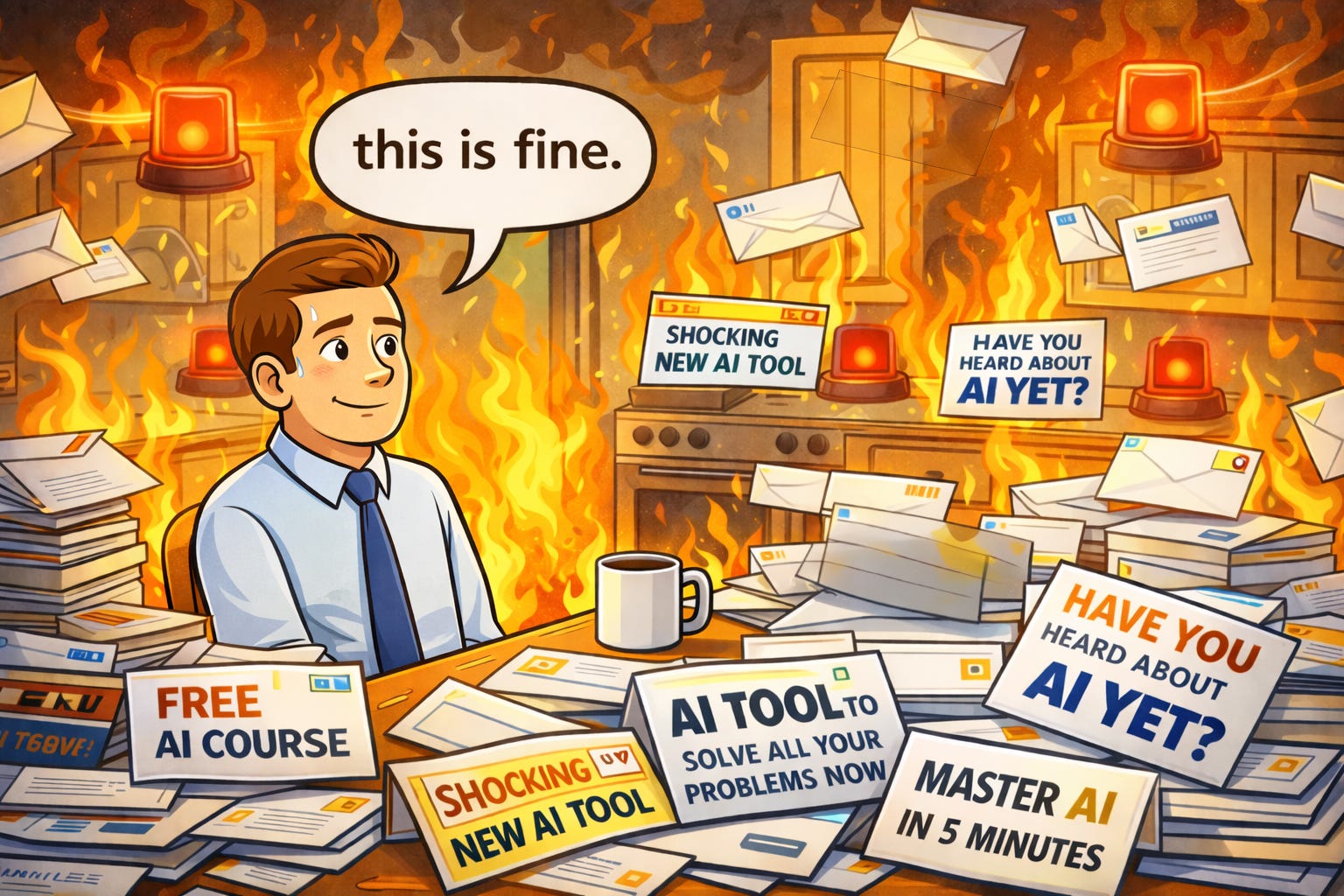
Despite over $300 billion of projected AI spending by enterprises in 2025 and almost 90% of knowledge workers using AI at work, only 5% of employees say they are using AI to transform their work. In addition, over half of employees do not trust AI systems and worry about AI taking their jobs. Meanwhile, executives continue searching for positive returns on their AI investments while their workforces continue to wrestle with widespread adoption.
After a year of speaking in board rooms or on stage about the impacts of AI, and countless conversations with discerning experts and leaders, it’s become clear why:
1. FOR INDIVIDUALS: The illusion of quantity = it is really hard to catch up and keep up with AI in a reliable way.
The vast majority of the “free” education offerings on the market are produced by the AI companies themselves (courses and academies from Google, AWS, OpenAI, Anthropic), resulting in predictably selective offerings that gloss over, or completely omit, the significant limitations, risks, and alternatives to their solutions. As the old saying goes, “free as in freedom, or free as in free beer?”
These offerings are useful for those specific tools and can be elements of a good AI education, but cannot be the education. It is like being sold a Chef’s blow torch, and expecting the complementary guide it comes with to teach you how to cook, or to be a reflection of a normal diet.
Because of the frenzied nature of AI, everyone and their uncle seems to be an expert and have a course to sell you, flooding your feeds, while the truly timeless perspectives and free materials by the true world-leading experts are long buried.
Every day there is a flood of new AI developments that is already a challenge to keep up with. However, on top of this, opportunistic individuals and marketers will each publish their own hot takes about these new developments, often using AI itself, producing a tidal wave of generic, low-grade engagement-bait slop and rip-offs masquerading as useful or original information.
The result: knowing where to start, catching up, and then keeping up, is basically its own job. For ordinary people it is overwhelming, deeply intimidating, and breeds skepticism, apathy, and/or fear.
2. FOR LEADERS: The vast majority of organizations have a glaring disconnect between the board room, their people, and actual results.
At an executive level, most leaders are behaving like AI is indeed a major development that could transform the economy and how their business exists, altering roadmaps and making investments accordingly. However…
At a staff level, most are attempting to convey this with education efforts that are wildly thin relative to the magnitude of the impact expected, as if AI is just another tool, rather than a career-altering, process-transforming reality. Overwhelmingly, AI education efforts are box-checking exercises that skim the surface of AI, are temporary, and produce weak evidence/ credentials.
There are zero incentive structures set up in most firms to make AI learning, and AI experimentation with what was learned, something that is publicly visible, celebrated, and rewarded in both status and benefits.
Ask most employees, and their situation sounds like this: “Once this introductory course or training is done, we hope you’ll go deeper and keep up on your own. Good luck! Don’t worry about all the headlines suggesting your job is in imminent jeopardy, or the dizzying array of perspectives that make it clear we’ve only just skimmed the surface. Here’s a clip art-style certificate of accomplishment to motivate you!”
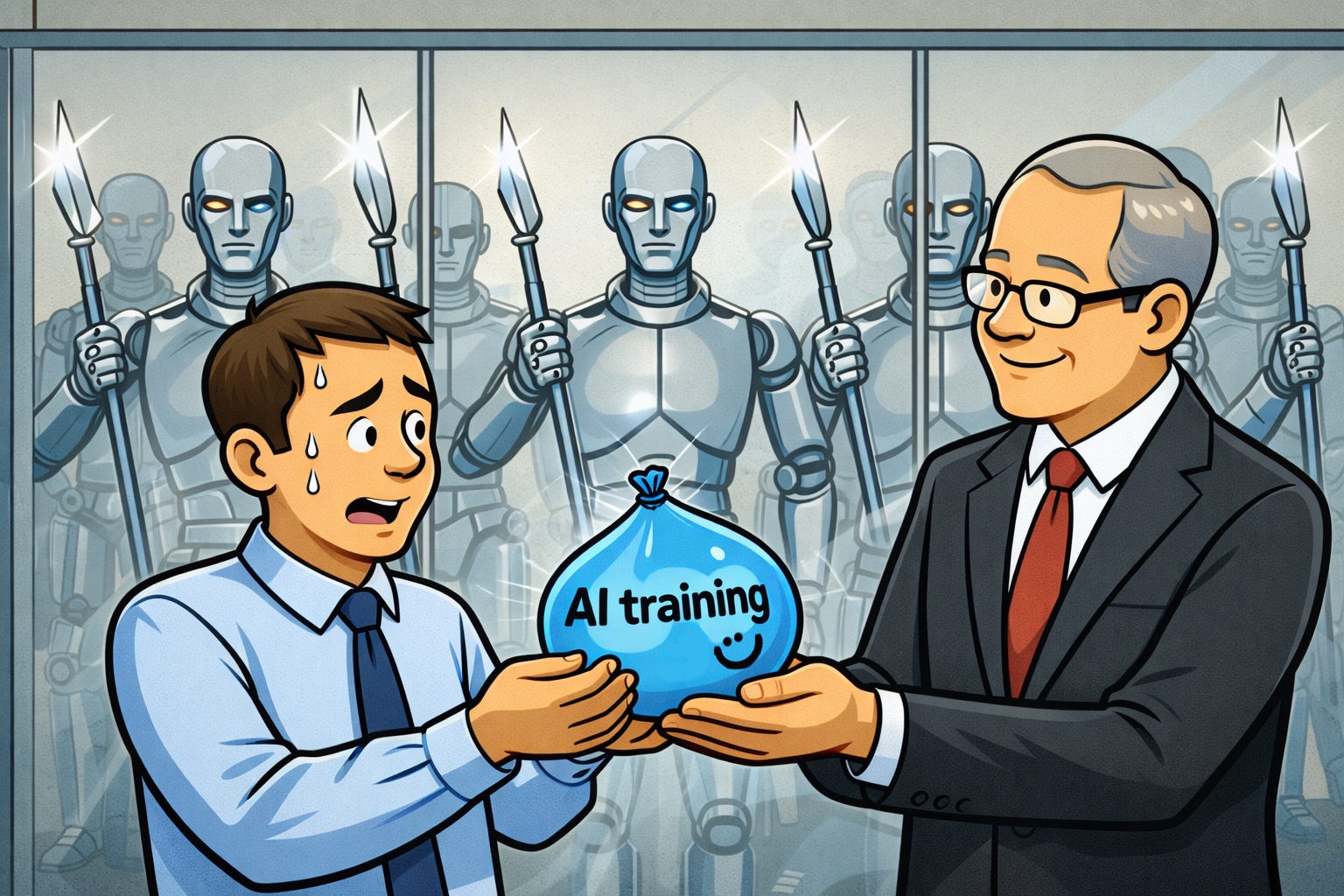
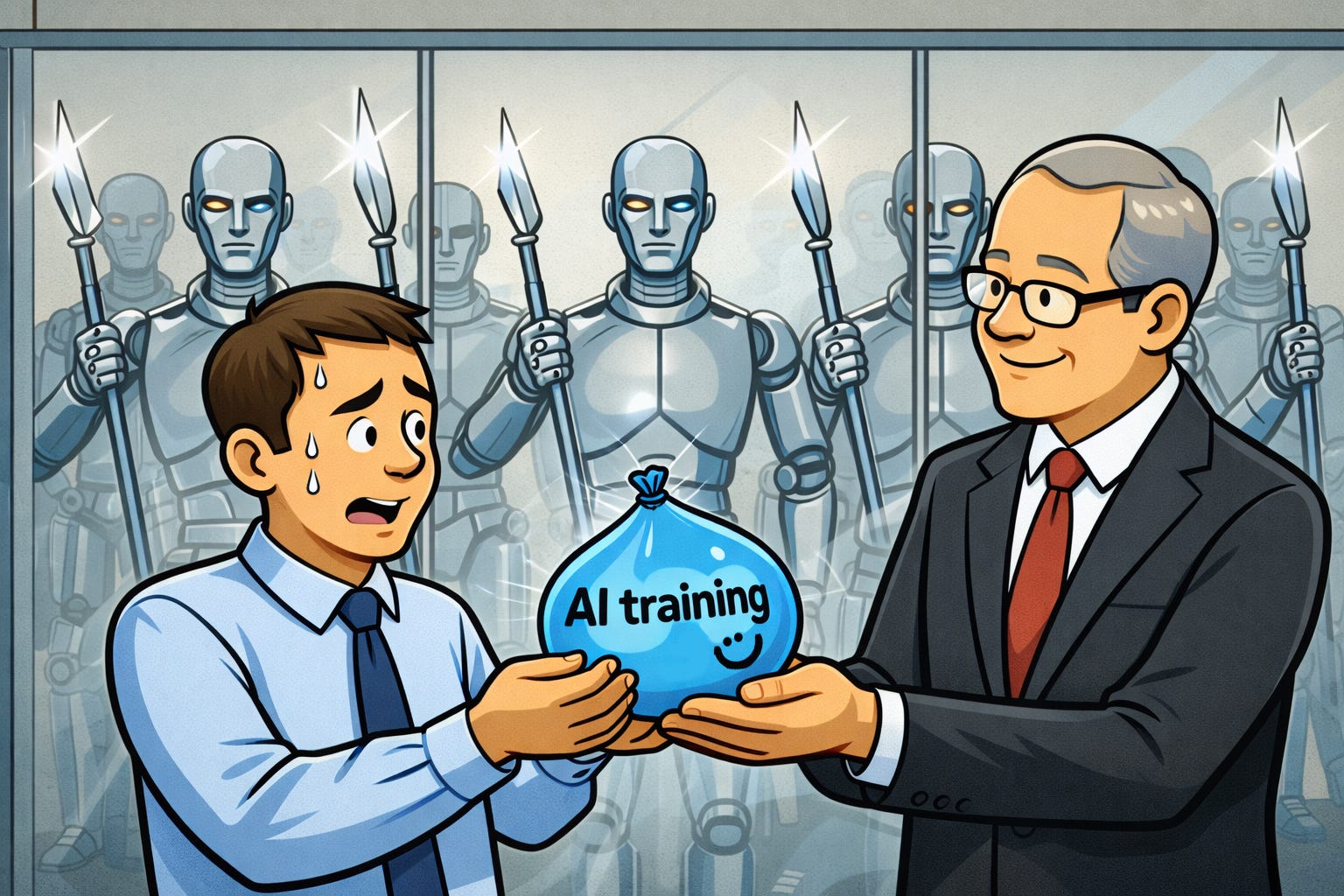
There is now also an army of experts offering Executive Education to corporate leadership teams. Once the training is over, they usually experience the same response: “how do you/ I scale this to all our people? And how will we keep staying up to date?” Nobody has had a good answer and most leaders aren’t in a rush to find an answer.
AI-based expectations have ballooned due to the disconnect. An Upwork Labs study painted a damning picture that matches what you’ll hear in many companies: the AI industry created a tantalizing wave of PR and heavily subsidized usage → executives updated timelines and expectations based on the seemingly guaranteed capabilities and adoption → employees, having AI effectively forced upon them, quickly discovered the sheer amount of rework and careful checking involved when using generative AI at work, resulting in unchanged timelines and often more work for them → pressure compounds on frustrated leaders who themselves often didn’t get educated on the fundamentals properly either before making commitments.
All of this sitting on a foundation of applying AI tools to old processes, instead of experimenting—making time for it, incentivizing it—with what was learned to improve processes to begin with.
Layered throughout: as awareness of the risk attached to these AI tools becomes more commonplace, top-down warnings are nervously issued, meanwhile none of the support is provided to help people truly wrap their minds around the logic behind the risk.
Simply put, once you take a closer took, the issue becomes obvious. If this is what the AI upskilling/ culture change market looks like, why are we surprised the vast majority of individuals aren’t buying in, in turn failing to deliver “AI ROI”?
3. People struggle with dualities, and generative AI is the most extreme kind
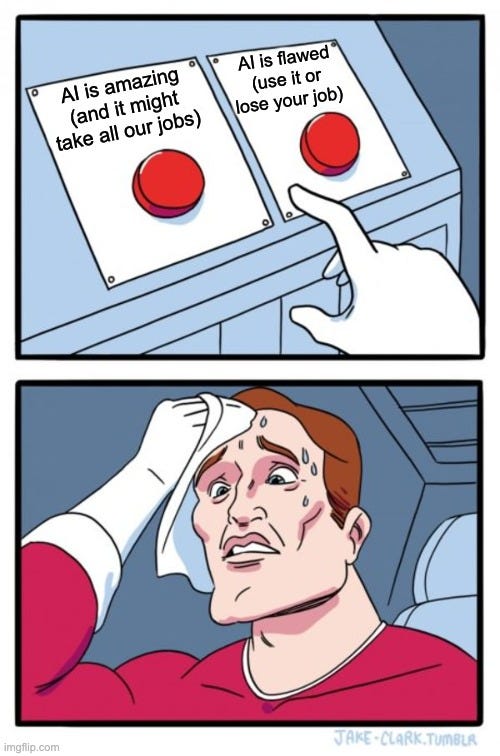
To top off all the above, AI forces you to reconcile seemingly opposing facts. The messy reality is that all of the following are true:
Generative AI is remarkable technology which can save you lots of time and improve the polish, well-roundedness, and market-ready quality of almost anything you wish to produce, often with astonishingly (dangerously) little effort.
“AI won’t take your job, somebody who is using AI will.” Some variation of this is now common knowledge. Cliché? Yes. True? Absolutely. See 1.
While at the same time…
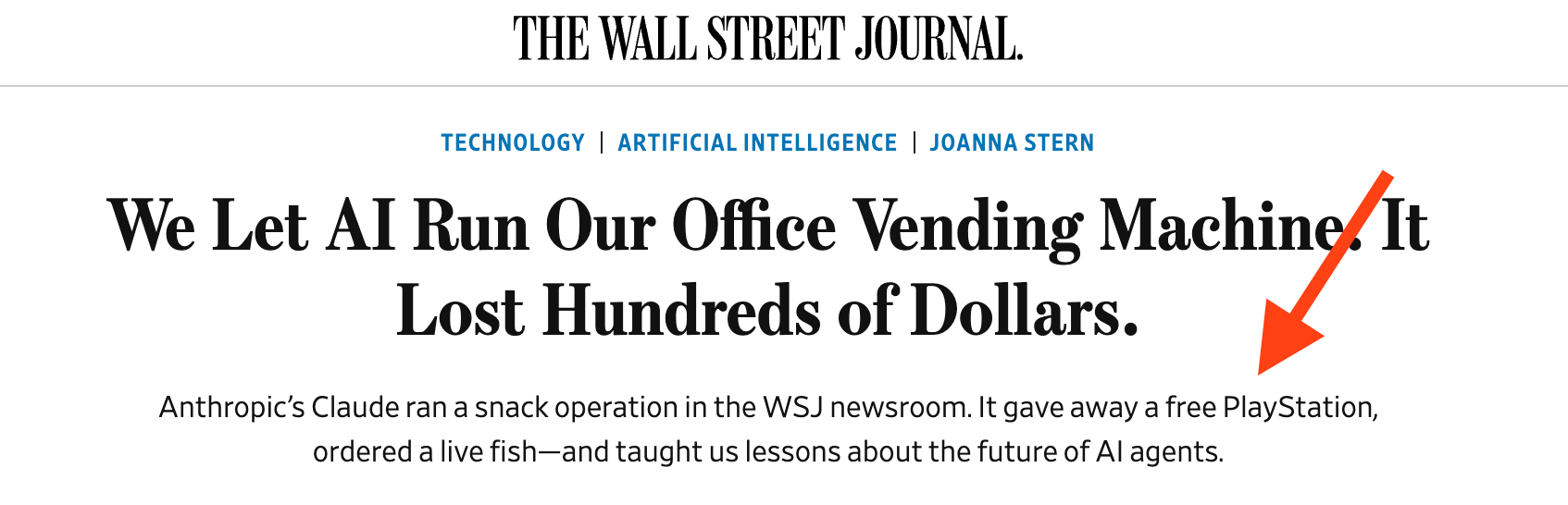
Generative AI is frequently and unpredictably stupid, and therefore dangerous when not used carefully, and this trait continues with every latest and greatest model we’re told is one step closer to God-like intelligence and functionality (see Anthropic’s most recent unintentionally hilarious AI vending machine self-own making the rounds).
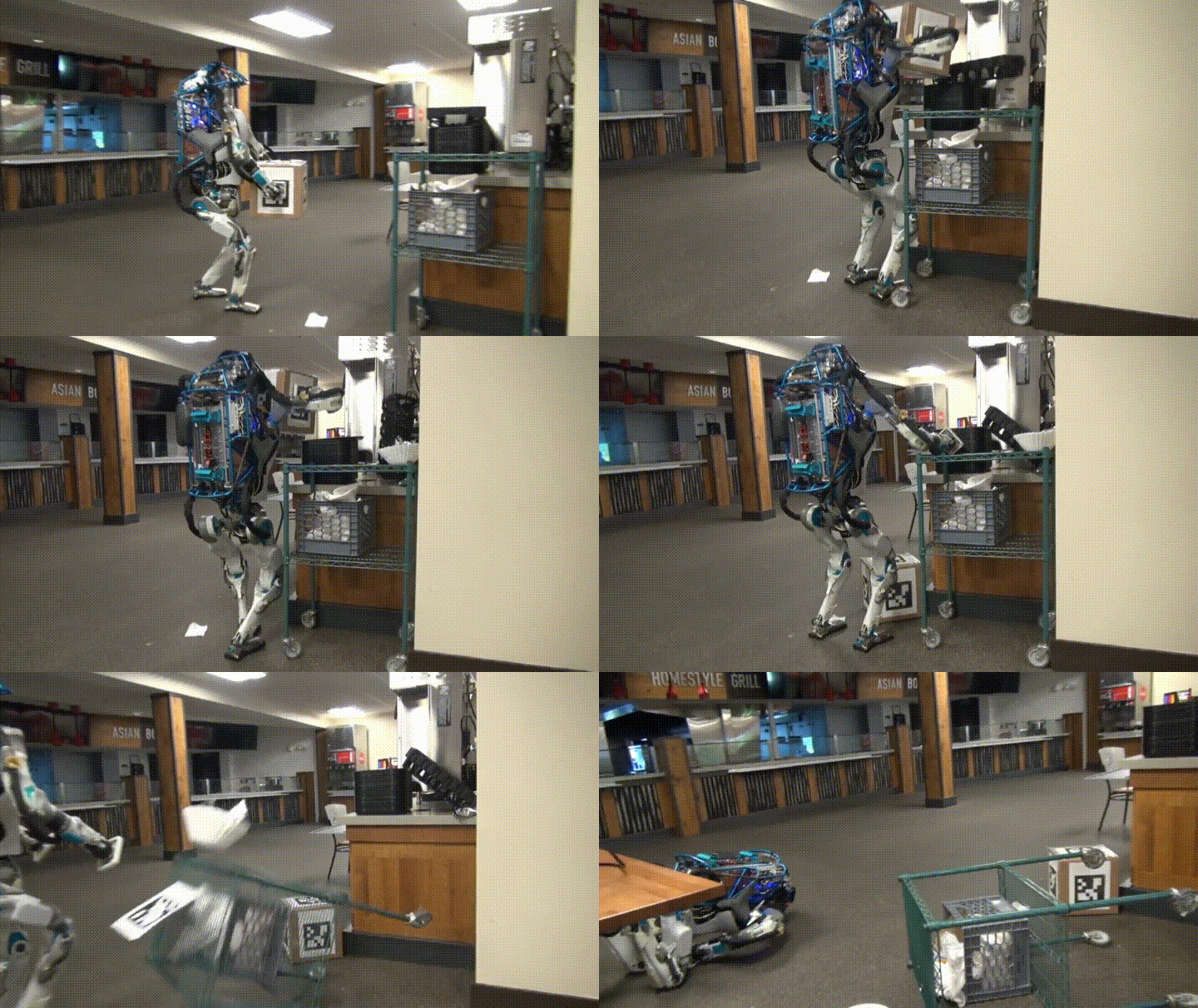
All these AI solutions are still, more often than headlines would have you think, the intellectual equivalent of this:
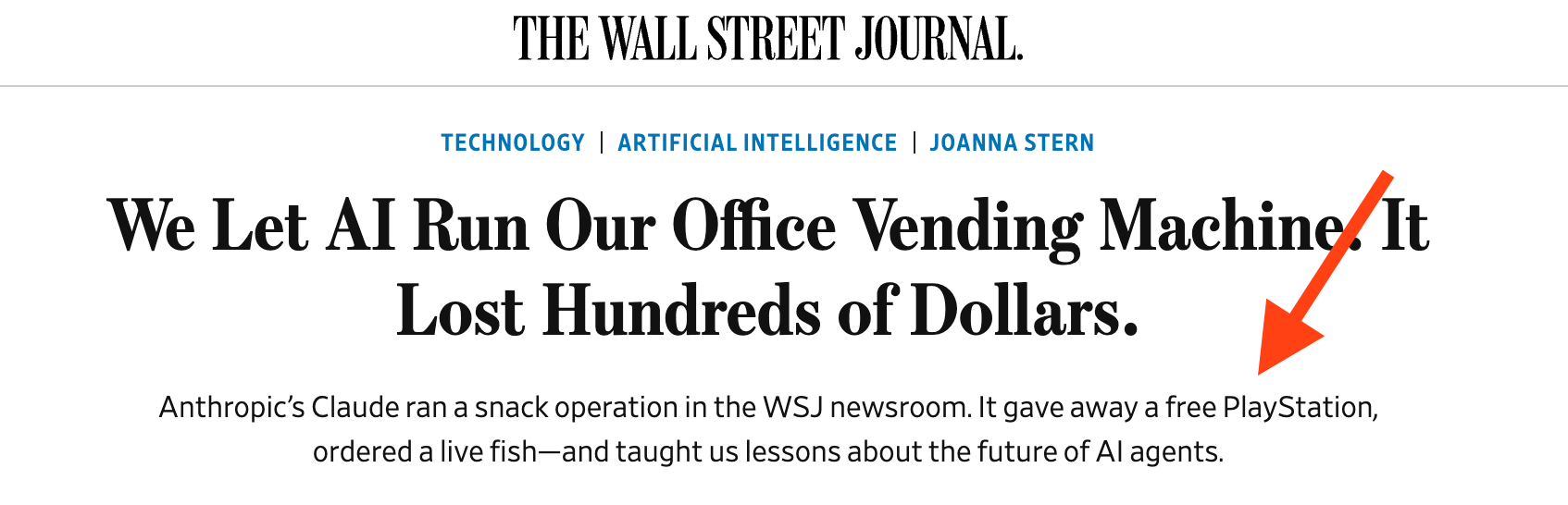
As the vending machine example illustrates—and is just the tip of the iceberg when it comes to more serious breaches and vulnerabilities—these systems we’re being asked to pin our careers and economies on, are not “intelligent” in the conventional human sense, and also wildly insecure.
Just as any power tool can be feared or mastered, wielded safely or dangerously, education is the key.
Making sense of the above duality requires nuance that can’t possibly be internalized in a one-and-done, top-down program, or simplistic self-serve courses, with minimal structural incentive, which is almost everything you’ll find on the market are right now. The necessary nuance is currently inaccessible to most people.
Add it up: any worthwhile AI education/ upskilling/ culture solution needs to check 7 clear boxes to get results
Why, not just what/ how.* The level of selective ignorance being mainstreamed by AI companies and AI hucksters is deeply unfair at best, dangerous at worst. Making hype-free AI education that teaches the underpinning elements of this wave more accessible is critical. It is the key to people who are confident and comfortable in what they’re being asked to reorient their work around, and leaders who aren’t having the wool pulled over their eyes by Big Tech PR. *This particular aspect was the original driving motivation behind TTAI.
Taming the noise. One of the heaviest tasks when it comes to AI education is finding the needles of timeless, ultra high value content in the infinite haystack of mediocre or downright bad content. Not just upfront, but in an ongoing basis. Which leads to the need to be…
Continuous. Any solution can’t be a one-and-done, but help somebody continue to stay on top. This is a challenge whether you’re AI aficionado or just getting started. Without this, people begin to fall behind again in a matter of weeks. And it needs to be…
Easy. People are busy and stressed as it is. Asking them to take on a second job of monitoring and parsing and making sense of AI is not realistic or fair. Every person needs their own personalized, effortless way to keep up that doesn’t add significant extra time and effort to their jammed day.
Making space for results. Where are you making room for AI experimentation? Have you walked the talk by carving out time for those who want to try? Or are you expecting your already-spread-thin people, half of whom believe this very same AI will get them fired, to voluntarily dig in? In tandem, you also need…
Motivation. What is it in for them? How are you formally and visibly recognizing their efforts? Do you have an AI innovation leaderboard? This is how culture shifts. And to drive it home…
Outcomes that matter. You are asking people to take a leap of faith they are often not comfortable with for a number of good reasons outlined above. At the very least, help them earn certifications and evidence of advancement that can credibly improve their opportunities today and tomorrow, and make them feel like they’ve picked up real, useful capabilities they want.
This is exactly what we’ve built with ThinkingThroughAI, and it’s as valuable for organizations—those who actually care to help their people, not just blindly checking boxes—as it is for individuals.
We are surrounded every day with things that are theoretically good for us, theoretically impactful, but we simply don’t have the bandwidth. Making it possible to overcome this challenge, and making it worthwhile is where real change can start. Generative AI presents us with an incredible, fickle tool like nothing we’ve ever experienced before. It’s essential we start acting like it.